
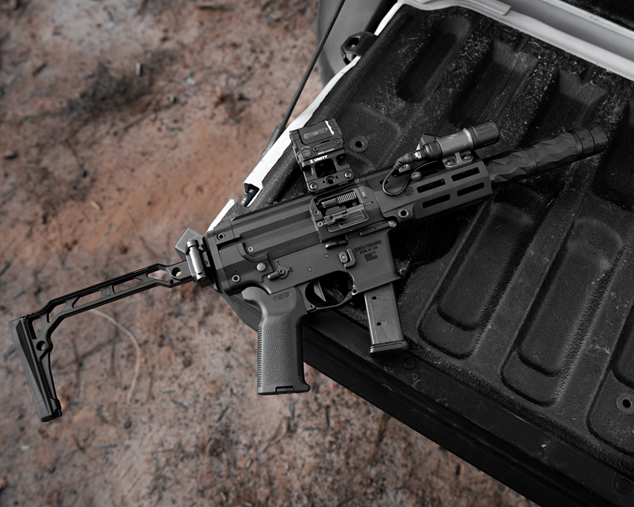
PCCs, or pistol-caliber carbines, are not rare. Roller-delayed PCCs, which rely on roller-delayed blowback operation as opposed to direct gas impingement, are. Most ARs and AR-style platforms use gas impingement, which requires a gas block, tube, a bolt carrier group with a gas key, and then a buffer system which consists of a tube that houses a spring and weights, to cycle the action.
Gas impingement is a time-tested action, and it is very reliable and consistent when properly tuned to the gun and cartridge, but there are some significant advantages that a roller-delayed blowback operation has over it.
Pair these with the advantages of a pistol-caliber build, and you have a real value proposition for a roller-delayed PCC; here it is.
Simplicity of the Action (Which Corresponds to Additional Benefits)
For all the virtues of direct gas impingement, they are not without their equal and opposite shortcomings.
First, if the gas system gets dirty, it can obstruct cycling, specifically if either the gas block or tube becomes occluded with fouling.
If a rifle is overgassed, it will incur excess wear on the bolt carrier group’s gas key, as well as on the recoil spring. If the rifle is undergassed, cycling will be erratic and inefficient.
Even if the gas system is tuned properly, if the buffer weights are not properly tuned to the gas system as well as to the cartridge, there could be adverse effects on cycling.
It is also the case that gas-powered rifles must be kept meticulously clean to uphold their intended performance.
In other words, a properly tuned and maintained gas-impingement rifle is a thing of beauty. But the keywords should be apparent. Any instance of design complexity is an opportunity for failure (or at least sluggish performance) and a gas system is ripe with those opportunities.
This is the first and most significant advantage of a roller delayed PCC. Roller delayed blowback operation solves all of the problems associated with direct gas impingement as well as those incurred by direct blowback.
To keep this as high level as possible, a roller-delayed blowback system relies on a system of rollers that lock into barrel trunnions and stay there after firing until the bore pressure drops slightly. Only then does the action unlock and the bolt move rearward, extracting, ejecting, and preparing to chamber.
A roller-delayed PCC’s system addresses the pressure-related issues of direct blowback (which is not suitable for rifle cartridges because the high pressures can deform the casings, or with higher-pressure handgun cartridges, like 10mm).
It also is much simpler in operation than a gas system. There is no gas block or tube to maintain with a roller-delayed PCC, and even a very dirty roller-delayed action is going to perform reliably. That’s no excuse not to maintain and clean your gun; only an observation that roller-delayed blowback actions deliver legendary reliability.
In addition, it is the case that roller delayed blowback operation is remarkably smooth, just like a gas impingement system, and since these actions require the bore pressure to drop before unlocking, there is far less port pop than there would be with direct blowback, or with an overgassed rifle, for that matter.
So, in other words, a roller-delayed PCC will be smooth-shooting, like a gas-impingement rifle, but it will be simpler and even more reliable, and have fewer parts to troubleshoot if the rifle’s cycling gets finicky.
Less Risk of Overpenetration
Another considerable advantage of building or buying a roller-delayed PCC as compared to a full-sized platform chambered in a rifle cartridge is that as a general rule, handgun cartridges produce a much lower risk of overpenetration.
Spitzer rifle bullets, such as those loaded into cartridges commonly associated with AR builds like 5.56, .223 and .300 BLK, produce high muzzle velocities and energies and will typically penetrate further than handgun bullets, even if the round in question is a hollow point.
Large, wide, heavy bullets such as those loaded into 9mm and 10mm cartridges are designed to dump their energy efficiently, not to penetrate excessively. The effect of reducing penetration is further minimized when an appropriate hollow point bullet is loaded.
This makes a roller delayed PCC much more appealing if you are looking into the carbine as a PDW, expressively to be utilized as a defensive platform. While many handgun cartridges produce less muzzle energy than common rifle cartridges, at close ranges, 9mm, .40 S&W, 10mm, and .45 ACP all produce more than enough stopping power to neutralize most threats effectively given appropriate shot placement.
Add a Roller Delayed PCC to Your Collection Today
As you can see, if you are looking for a smooth shooting PCC with a reliable, simple action and one built around a cartridge that will stop a threat without producing an excessive risk of penetrating too far, a roller-delayed PCC may be just what you’re looking for. Explore our collection, get familiar with our ZF-9 and ZF-10, and if you have questions, get in touch with us directly.