
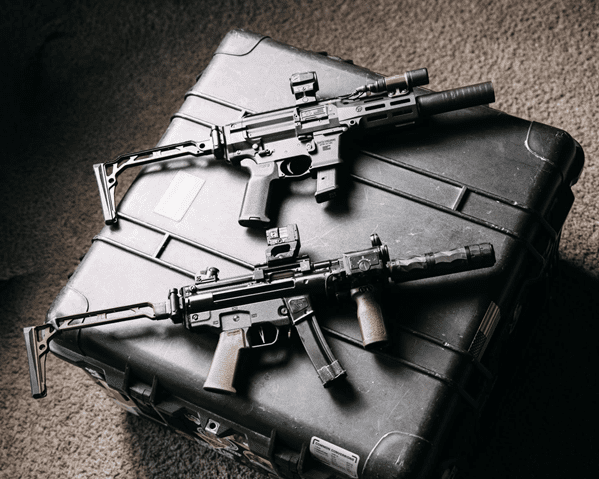
Considering purchasing a roller-delayed PCC and wondering whether a 9mm or 10mm chambering is better for you? You’re in the right place. We’ll break down the differences from a high level here.
High Level Overview
To keep things as simple as possible, the 9mm Luger is a smaller, more affordable cartridge than the 10mm. It produces less recoil, less muzzle flip, and less stopping power. It is also more ubiquitously available. That said, let’s drill down a little deeper.
Cost and Availability
Not only are there many more guns available chambered in 9mm Luger than in 10mm Auto, but 9mm ammo itself is more widely available and considerably more affordable.
Pretty much any gun shop will carry some 9mm loads (even if they don’t have exactly what you’re looking for) whereas 10mm is a little harder to find (and, as stated, more expensive).
Cost alone is a good reason to choose 9mm if you primarily target shoot, or if you engage in any other sort of other high-volume shooting discipline. The extra cost and stopping power of 10mm don’t offer any value if all you do is target shoot.
Recoil and Muzzle Jump
The 9mm Luger produces considerably less recoil than 10mm Auto, and in similar firearms, much less muzzle jump as well.
Now, there are things you can do to mitigate felt recoil and muzzle jump, but regardless, they will be worse with 10mm than with 9mm.
Depending on load data, 10mm Auto will produce recoil between 10 and 12 ft-lbs, on average, whereas 9mm will only produce recoil between 4 to 8 ft-lbs. That delta is considerable enough with a shoulder-mounted arm like a rifle or carbine but is far worse with a handgun.
In this case, we’re talking about a roller-delayed PCC, so it’ll be easier to control recoil than it would be with a handgun, and there are some other things to keep in mind here.
Now, our roller-delayed PCCs are built around our roller-delayed blowback system, which is smooth shooting and which produces less recoil than other action types (like direct blowback). The system also responds well to suppression, which will also cut recoil.
Alternatively, you could install a compensator, which will help reduce recoil and muzzle jump.
But, regardless, for recoil-sensitive shooters, as well as for beginners, lighter, and smaller-framed shooters, it will be harder to control the recoil of 10mm than it will be to control a roller-delayed blowback 9mm.
Stopping Power
The 10mm Auto fires a larger and considerably heavier bullet than the 9mm cartridge does. Even heavier, +P 9mm loads are not going to be able to match 10mm for stopping power.
Let’s look at muzzle energy to make a comparison here. Depending on load data, the 9mm can produce muzzle energies between 350 and 400 ft-lbs on average. Also dependent on load data, the 10mm Auto can produce muzzle energies between 500 and higher than 750 ft-lbs.
This alone is significant, with no other context needed. It is also the case that the 10mm Auto produces a wider wound channel than the 9mm, although this is relatively negligible considering the similar diameter of the bullets.
Now, there is a tradeoff that should be considered here, since a shooter needs to be able to balance recoil control and the speed of follow up shots with stopping power. Good shot placement is almost always more important than stopping power.
It should also be considered that 10mm produces greater cavitation, which refers to the temporary wound cavity that is generated behind the bullet. Greater cavitation results in more tissue damage, blood loss, and trauma; giving the edge to the cartridge that produces more pronounced cavitation.
However, if pure stopping power alone is the main consideration you’re making in the purchase of a roller-delayed PCC and you’re between 9mm and 10mm, the latter is the better option.

Capacity
One final note is that, if you hold everything else equal, firearms chambered in 9mm will tend to have slightly more favorable capacities simply because the 9mm cartridge is smaller so more cartridges can be fit in a more compact space.
Of course, this should be balanced with the fact that 10mm produces so much better stopping power, but it is still something to keep in mind.
Which Chambering Is Better for Your Roller-Delayed PCC?
Our roller-delayed PCCs are available here in both 9mm and 10mm. If you don’t mind the high cost and extra recoil of 10mm because you prefer significantly higher stopping power, then 10mm is a good choice for you. On the other hand, if you value capacity and affordability, or if you do a lot of target or competition shooting, chances are 9mm is better for you.
You can learn more about our roller-delayed PCCs here or get in touch with us for more information. Let us know if you have any questions before you buy and we will assist.