
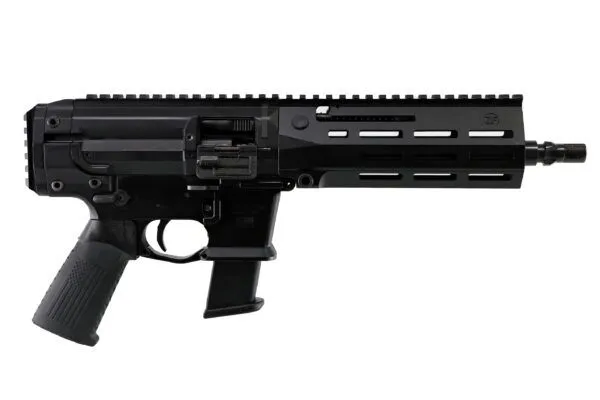
Building or buying a roller-delayed PCC can offer you a lot of flexibility that rifle-caliber builds just won’t.
For one, a PCC will be shorter and more compact than most rifle-caliber builds (unless you are looking at the potential to build an ARP) and on top of that, handgun ammo is generally cheaper and produces less recoil than rifle cartridges.
Plus, a roller-delayed system is simpler than a gas-impingement action and smooth-shooting, with no tuning as well. So you have a lot of arguments in the camp of a roller-delayed PCC.
But you still need to settle on a cartridge, and though common, not every PCC is chambered around 9mm. One alternative that will offer a lot more power is 10mm.
But is the step up necessary? Let’s take a closer look.
10mm Ballistic Performance
Developed in 1983 and at one point in official use by the FBI, the 10mm Auto cartridge is a rimless, straight-walled handgun cartridge developed from the .30 Remington.
It fires a fairly large, heavy bullet, typically weighing between 77 and 180 grains, so there is quite a great deal of variety in terms of bullet mass and power delivered, depending on other load data.
Regardless, accounting for all of this, the 10mm Auto produces higher energy, more stopping power, and a wider permanent wound channel than smaller alternatives like 9mm. In fact, it can deliver even more energy in some cases than magnum loads like .357.
To put things in perspective, the 9mm produces a rough average of 350 ft-lbs, depending on bullet weight and other load data. The 10mm Auto produces considerably more, from 490 on the lower end to more than 700 ft-lbs on the higher end.
This is quite a range, and of course is largely dependent on load data, primarily bullet weight, but one way or the other, the 10mm Auto produces considerably more stopping power, at least on paper, than the 9mm.
The higher stopping power, paired with the wider wound channel, means that at least on paper, the 10mm Auto is better as a defensive cartridge. There are however some other items that should be addressed here.
One is the risk of overpenetration. Delivering such high muzzle energies means that, at least at close ranges, there is a risk of overpenetrating the target. This can be mitigated by using appropriate, hollow point defensive rounds, however.
Another thing to consider here is that of recoil. The 10mm Auto produces considerably more felt recoil than 9mm, which should be expected considering the higher muzzle energy.
However, although this is the case, and although the 10mm Auto is notoriously difficult to control when fired from a handgun, with a roller-delayed PCC, you will have a few things going for you.
One is that the PCC is shoulder-mounted. This means you should be able to better control the force of felt recoil, considering a PCC handles much more like a stocked rifle than a handgun.
To make a reasonable comparison here, the 10mm Auto can produce somewhere between 11 and 13 ft-lbs of recoil energy. To make things somewhat comparable, .308 Winchester, a common rifle chambering, generates between 13 and 15 ft-lbs of recoil energy.
Most shooters have little to no issue shouldering the recoil of .308 Winchester, especially in a sporting rifle with a smooth-shooting gas system. If you can do so, then 10mm in a pistol caliber carbine shouldn’t be too much for you to shoulder, no pun intended.
Another thing to keep in mind here is that our roller-delayed PCCs, as the name suggests, are built around a roller-delayed blowback system that is exceptionally smooth shooting, especially compared to direct blowback or recoil operation.
And, on top of that, if you are really concerned about recoil, you can either mount a muzzle brake or a suppressor to the muzzle threads of one of our roller-delayed PCCs. Both a muzzle brake and a suppressor will reduce recoil, and it’s worth noting that in the case of the latter, our roller-delayed system suppresses well. So you have that option, too.
At the end of the day, there are a lot of features of our 10mm roller-delayed PCCs that make them attractive as defensive platforms, and which are well-suited to the high recoil of that cartridge. If you’re looking for something that offers more power than the 9mm, 10mm might be a step in the right direction.
Other Considerations
On top of that fact that 10mm Auto produces more stopping power and recoil than 9mm, there are some other things to keep in mind here.
One is that, on top of being a larger cartridge that will produce more recoil, 10mm Auto is going to be more expensive than 9mm. Therefore, if you do a lot of high-volume target shooting, it’ll cost more with this cartridge.
To be honest, there’s no reason at all to get a 10mm for target shooting or training. It’s more expensive and the power is wasted. If you’re interested in a roller-delayed PCC for training, plinking, or competition, the 9mm model works better.
Also, while there is a good deal of variety in 10mm loads, you’ll have much more variety in 9mm, so keep that in mind too.
Lastly, loaded 10mm mags are heavier, and take up slightly more space, so recognize that your overall loadout will be bulkier and heavier with 10mm than it would be with a 9mm alternative.
But, at the end of the day, if stopping power is the primary issue for you, 10mm Auto can be a great chambering for a roller-delayed PCC.
For More Information on Our 10mm Roller-Delayed PCC
If you’re interested in learning more about the roller-delayed PCCs we carry here at Zenith Firearms, investigate them via the previous link or get in touch with us directly at [email protected] or at 434-202-7790. Contact us, let us know what you’re looking for, and we’ll be happy to assist before you buy.